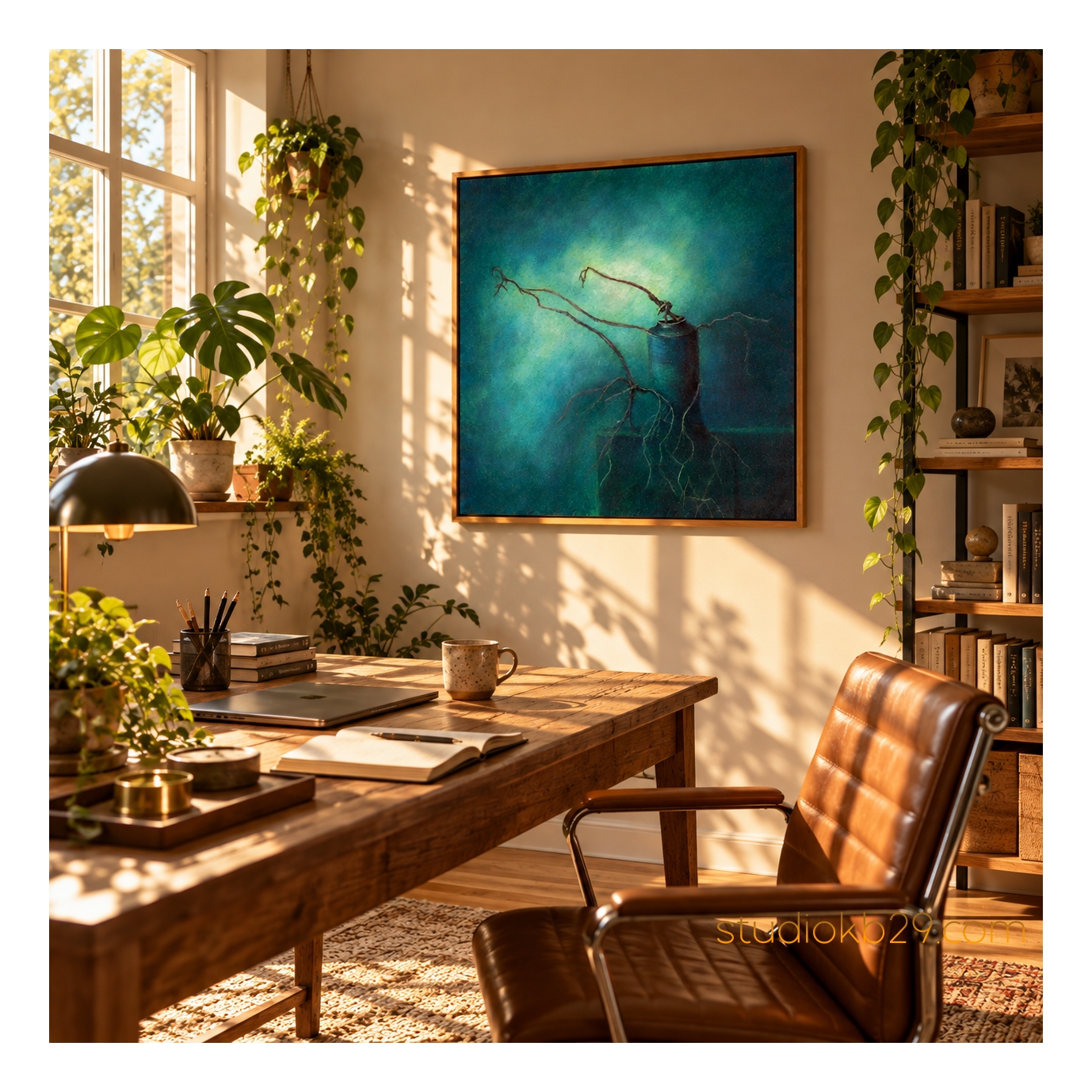
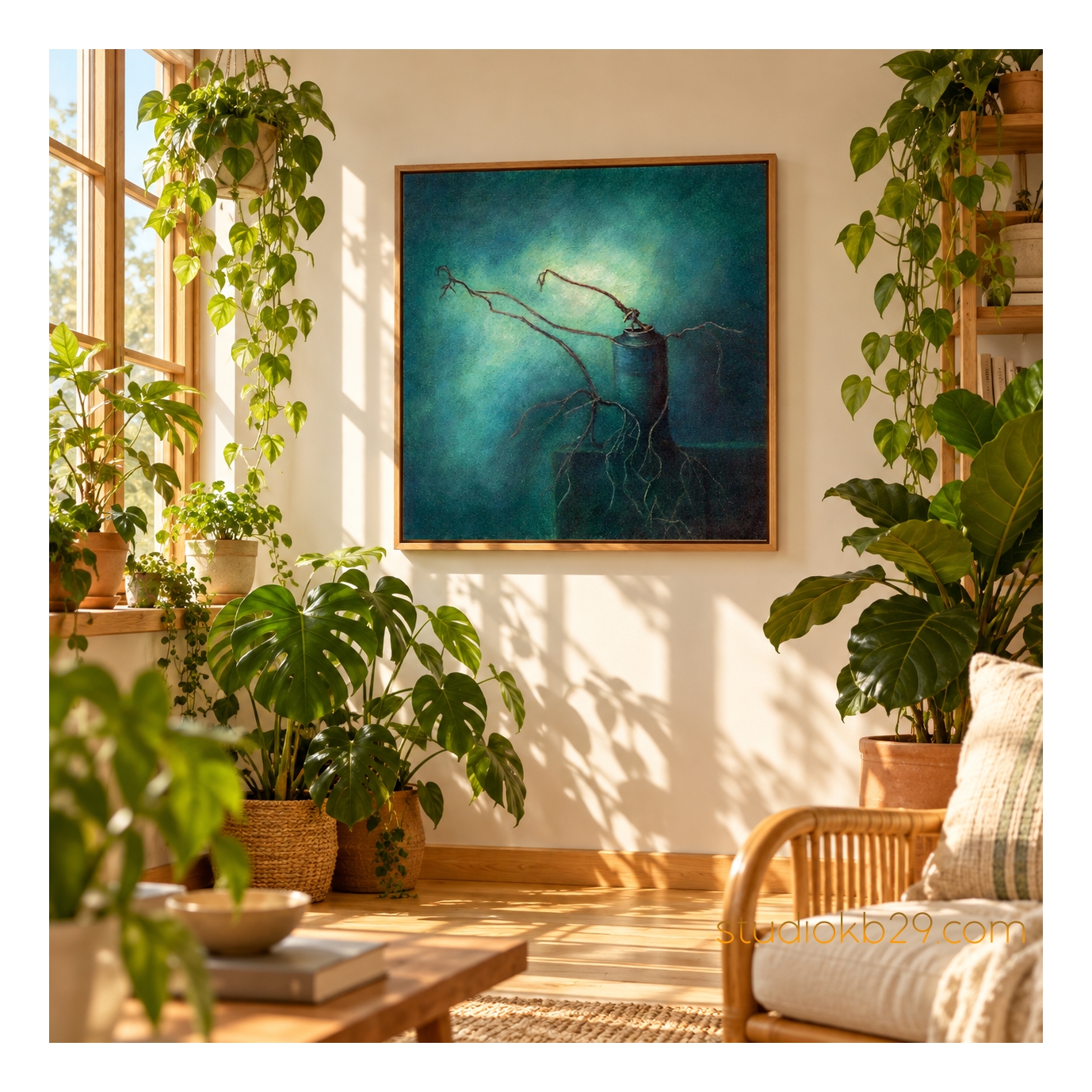
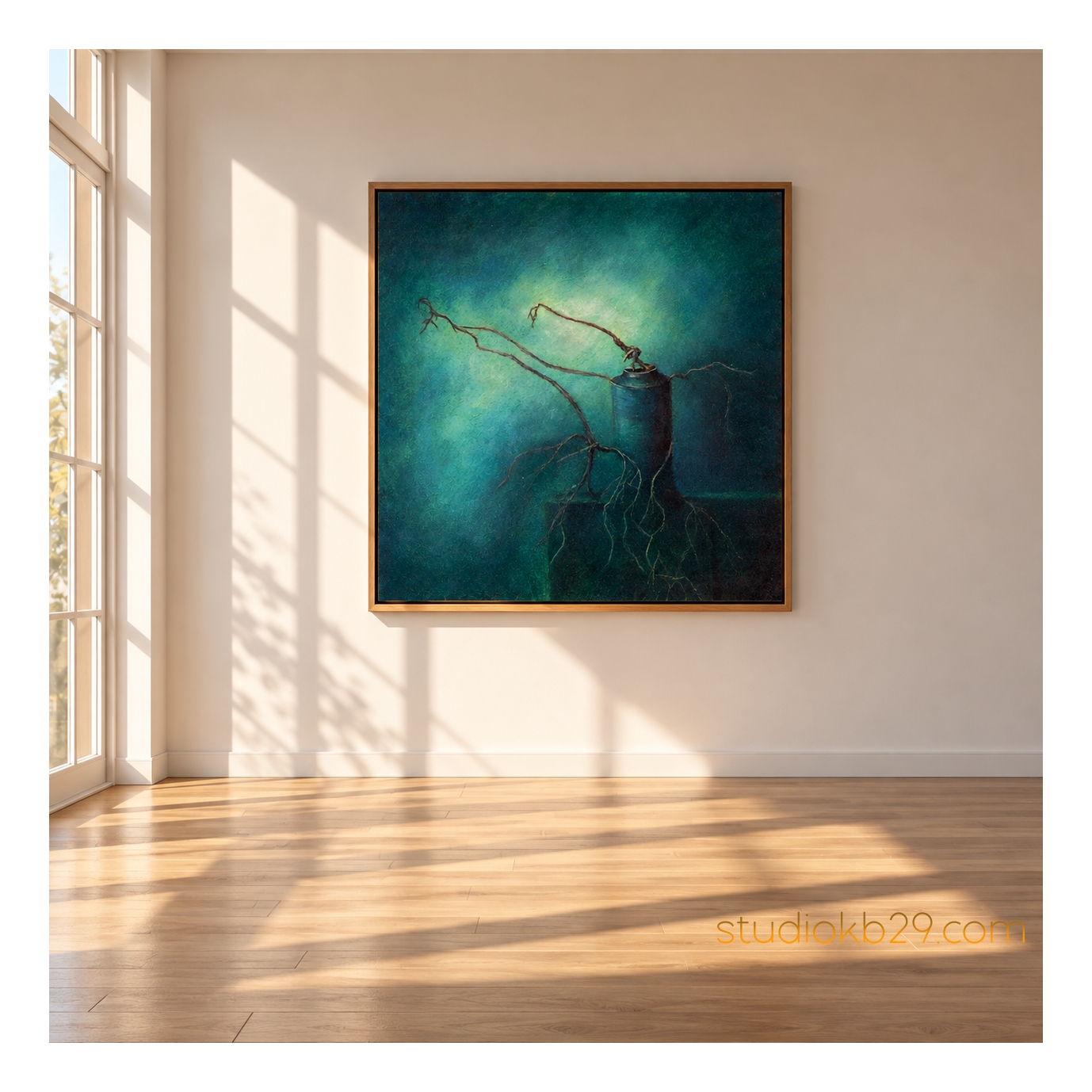
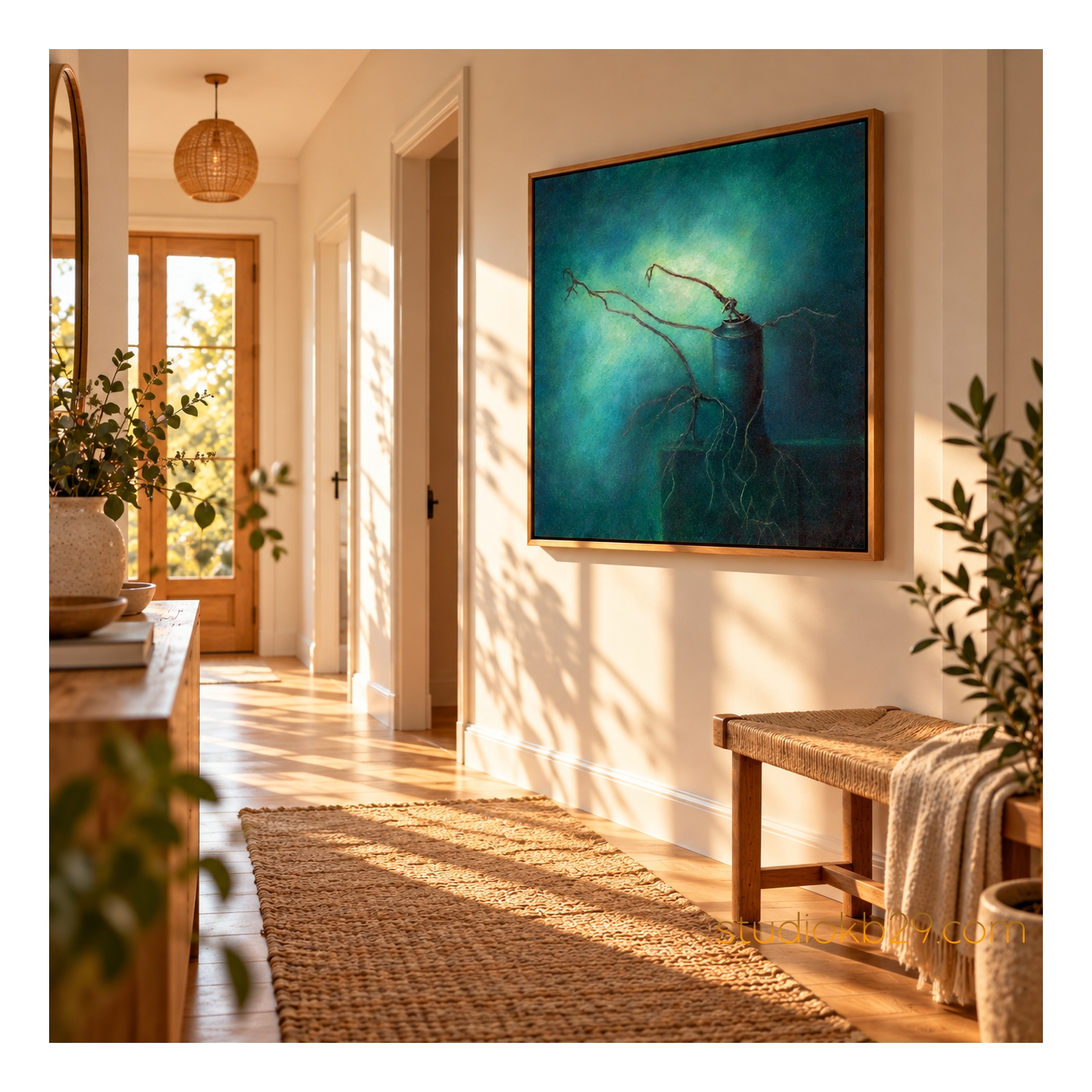
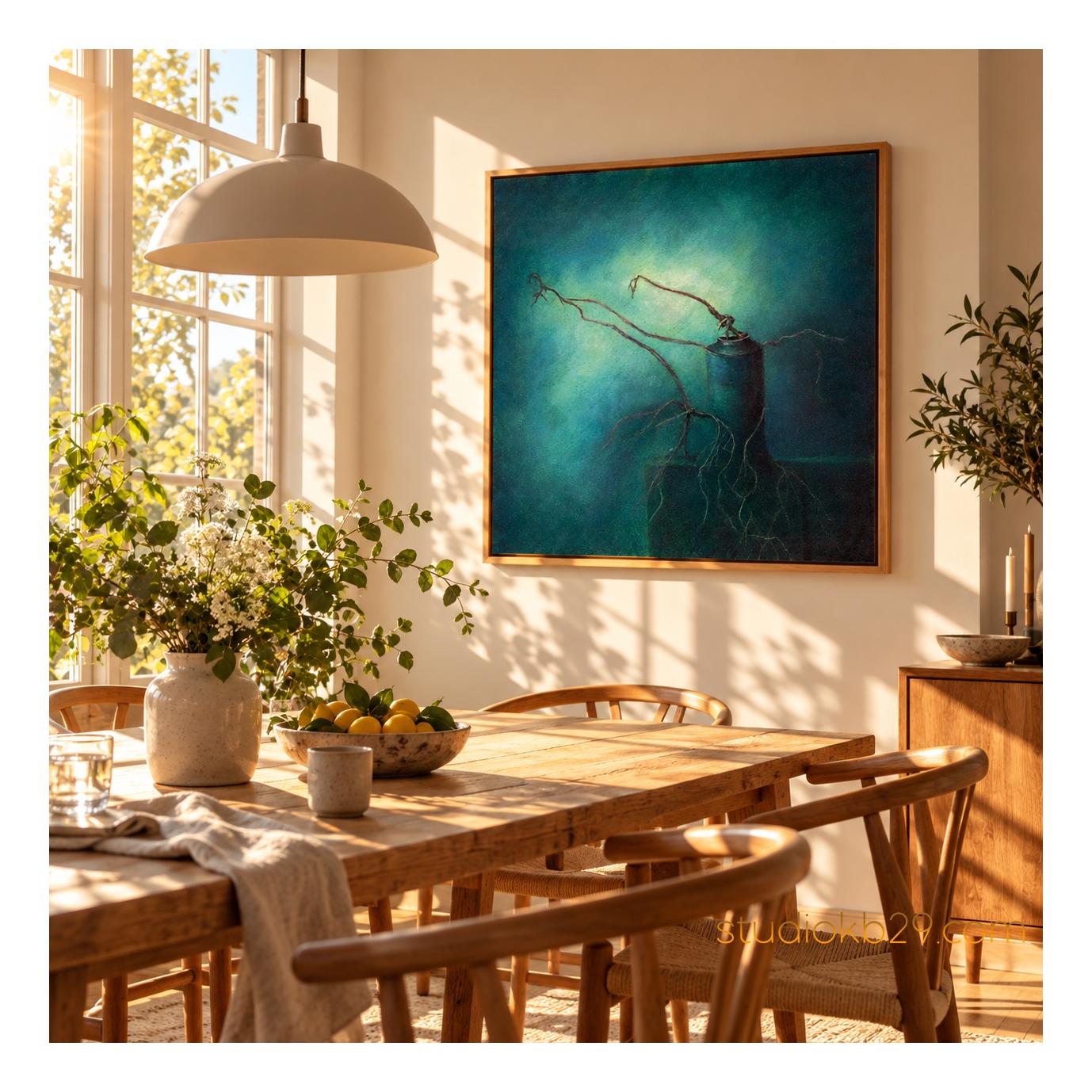
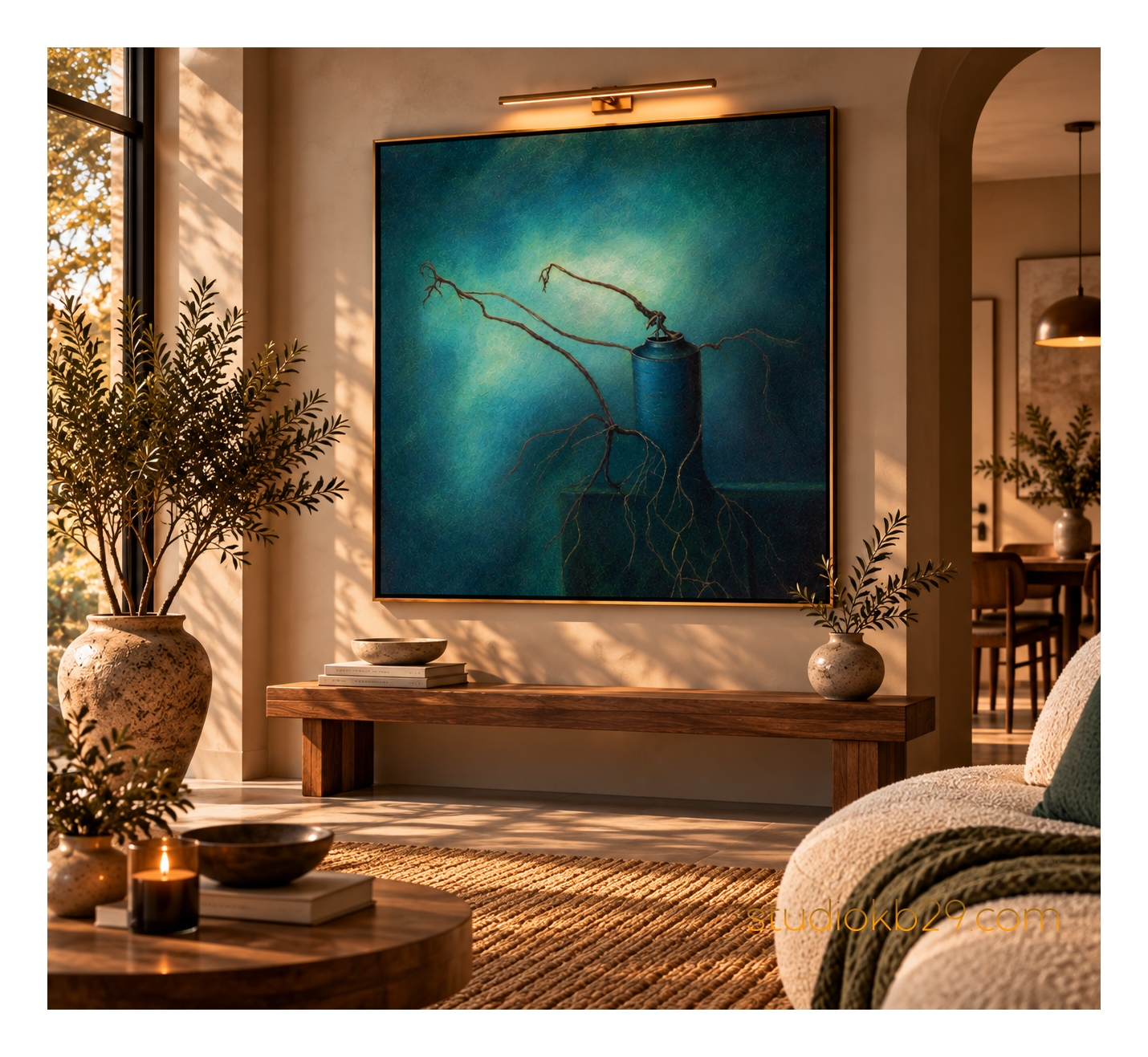
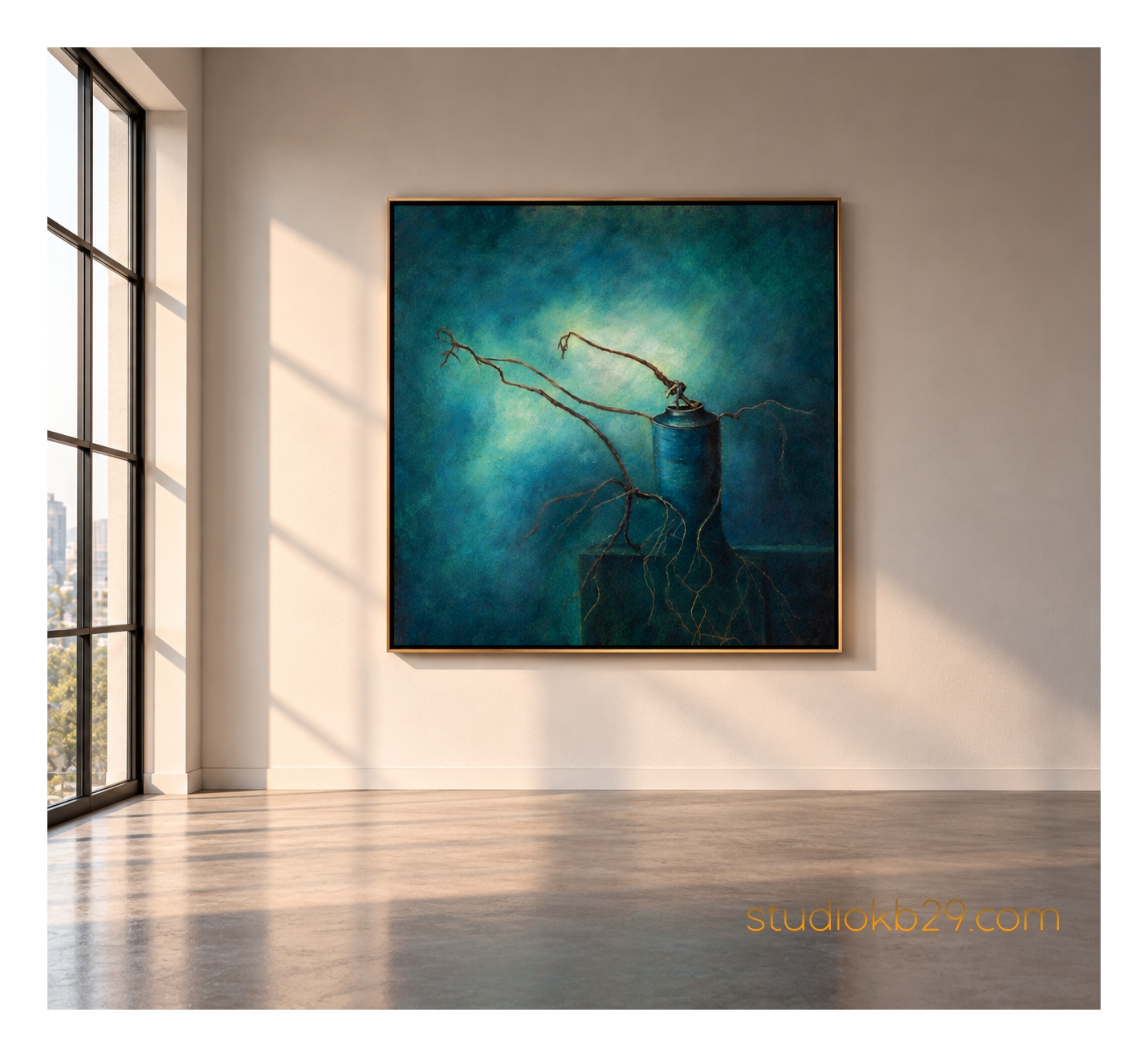
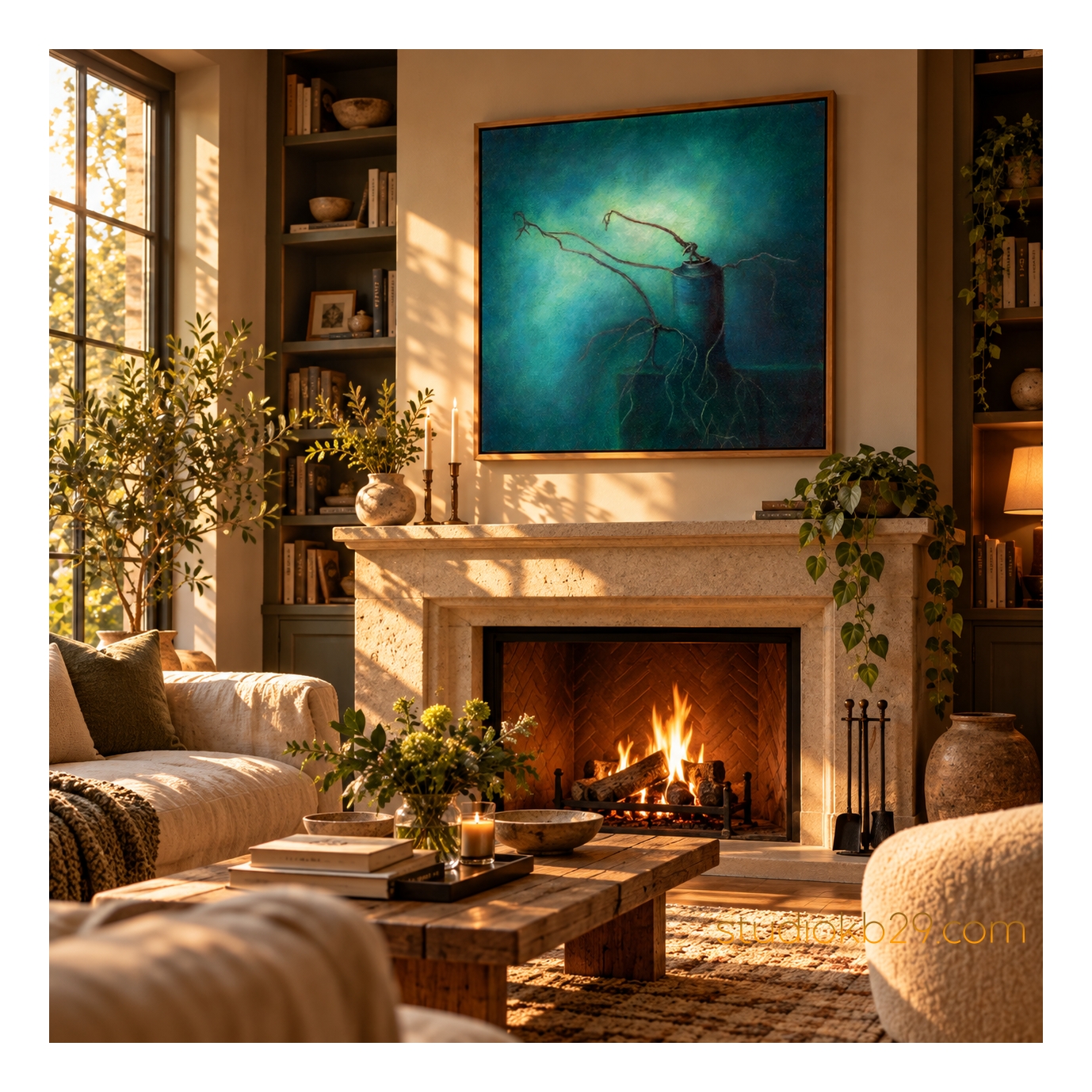
Description
An Imaginary Structure Between Matter and Life
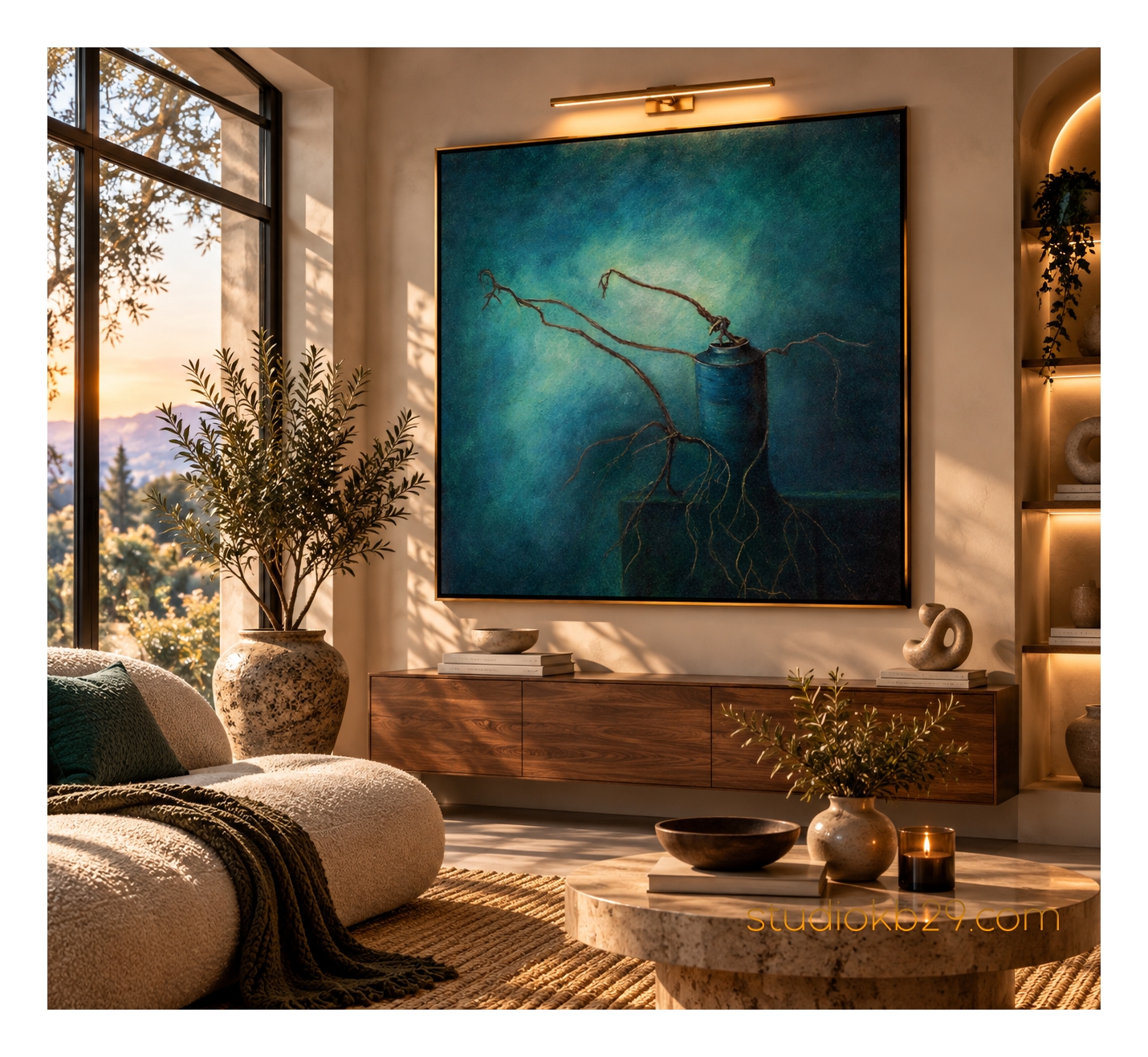
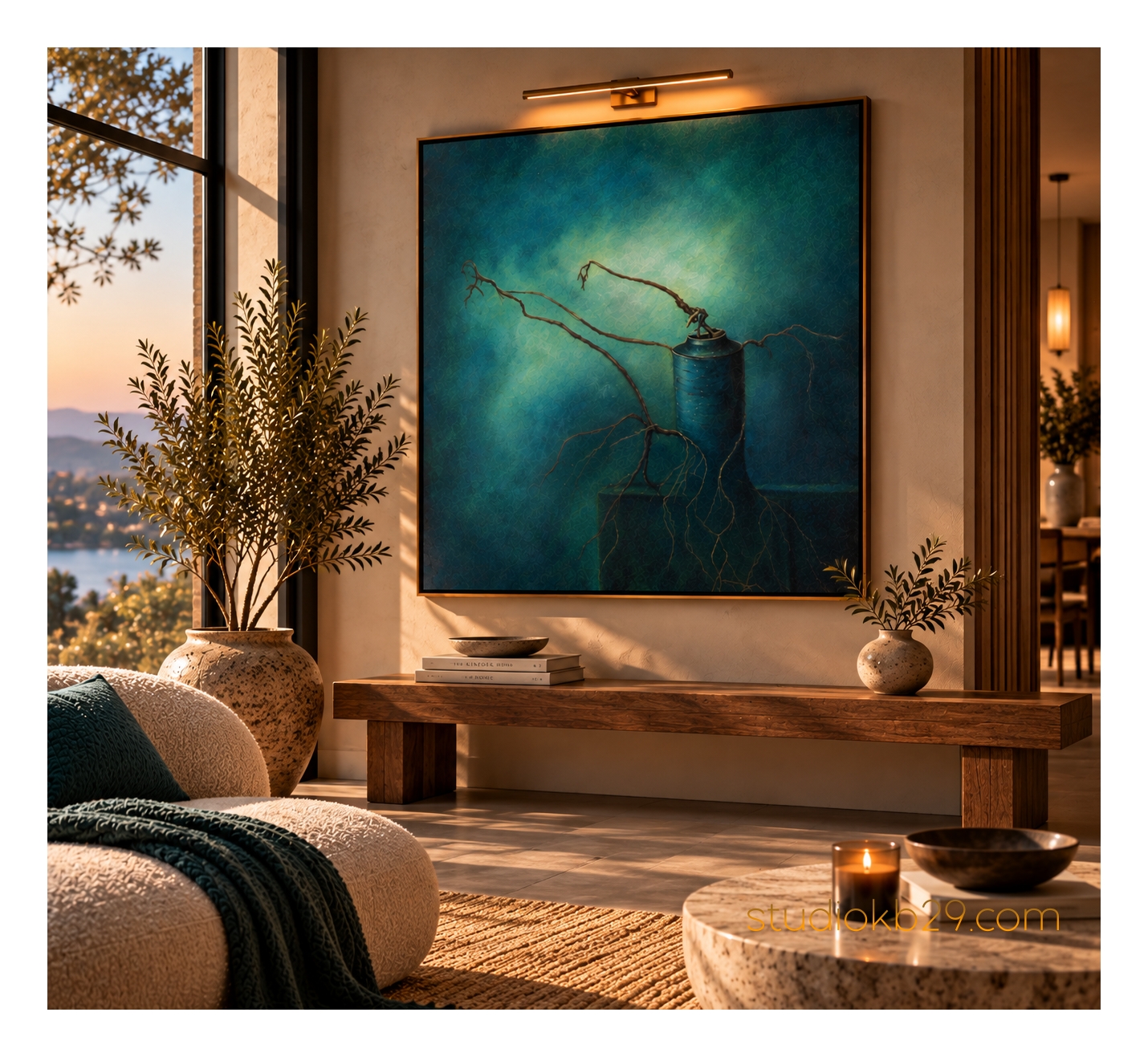
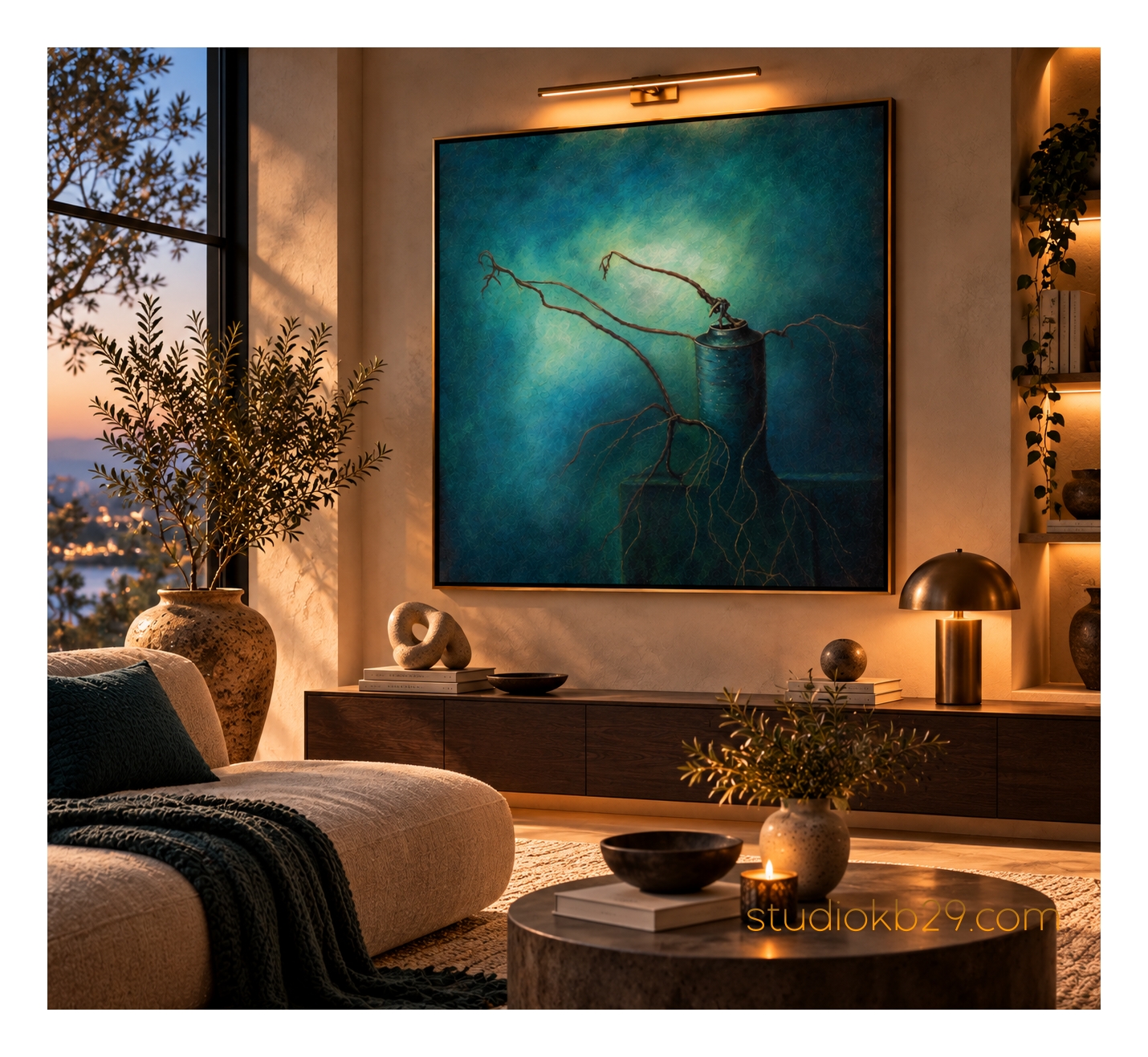
Suspended within a deep, atmospheric field of teal, turquoise and shadow, an enigmatic cylindrical form becomes the centre of an unusual organic arrangement. Fine, irregular branches extend from its upper and lower sections, reaching outward like fragile roots, delicate nerves or remnants of an unfamiliar living system.
The structure occupies a space between the mechanical and the organic. Its solid, contained silhouette contrasts with the branching lines that emerge from it, creating an intriguing tension between physical substance and delicate movement. What initially appears stable gradually becomes uncertain as the surrounding forms extend into the atmosphere, dissolving the boundaries between object, organism and environment.
A luminous area of turquoise and pale aqua gathers behind the central structure, illuminating the surrounding darkness without fully revealing its origins. The colour field creates a sense of depth and suspended movement, while the darker petrol and blue-green tones at the edges give the composition an almost weightless, dreamlike quality.
The fine branches appear to reach into an undefined space, connecting distant points without establishing a clear destination. Some extend horizontally, while others descend in delicate, root-like pathways. Their irregular contours suggest a structure that has evolved according to its own unfamiliar logic.
Nothing in the composition resolves into a conventional narrative. The cylindrical form could suggest a vessel, a fragment of an imagined machine or an unfamiliar organic structure, while the branching lines evoke traces of life without representing a recognisable organism.
The artwork instead invites the viewer into a world where material forms seem to retain connections beyond their visible boundaries, creating an atmosphere of quiet mystery and contemplative tension.
The Memory of Connection
At the heart of this composition lies the idea of connection as something that persists even when its origins remain uncertain.
The central form provides a point of concentration, yet the delicate branches extending from it draw the eye outward into the surrounding space. Their fragile, uneven lines establish a network of relationships that appears to exceed the physical limits of the object itself.
These connections are neither entirely botanical nor mechanical. They occupy an ambiguous territory in which roots, nerves, cables and abstract pathways become possible associations rather than fixed interpretations.
This uncertainty gives the artwork its distinctive surreal character. The structure appears to belong to an imagined system whose purpose and history remain unknown. Its lines may suggest growth, communication, memory or the remnants of a connection that once extended much further.
The image does not explain what has happened or what might happen next. Instead, it captures a moment of suspension, allowing the viewer to contemplate the quiet persistence of connections within an unfamiliar world.
Between the Mechanical and the Organic
One of the defining qualities of the artwork is the contrast between its central cylindrical form and the irregular structures surrounding it.
The cylinder introduces a sense of physical weight and geometric restraint. Its relatively solid silhouette establishes a visual anchor within the composition, while its dark blue-green surface blends subtly into the surrounding atmosphere.
In contrast, the branching lines are delicate, irregular and unpredictable. They extend beyond the central form in directions that feel intuitive rather than engineered, creating an organic counterpoint to its contained geometry.
This relationship suggests an imagined encounter between two different visual languages: the controlled simplicity of a constructed object and the restless complexity of organic growth.
Yet neither element remains entirely separate from the other. The central form appears to give rise to the branches, while the branches seem to transform its identity, making it difficult to determine where the object ends and the imagined organism begins.
The result is a surreal composition that explores the space between structure and emergence, containment and extension, matter and the suggestion of life.
An Imaginary Network of Roots and Pathways
The branching lines provide the composition with its distinctive rhythm.
Across the upper section, elongated forms reach outward in thin, angular movements, creating a sense of distance and fragile continuity. Below the central cylinder, finer lines descend and divide, suggesting a hidden network extending into an unseen environment.
These forms evoke roots, nerves or delicate conduits without belonging definitively to any of them. Their irregular paths create an impression of complexity, while their fine contours preserve a sense of vulnerability.
The eye follows these lines through the composition, moving between the solid central form and the open spaces surrounding it. This movement creates a visual experience that is less about a single focal point than about the relationships between multiple elements.
The branches appear to connect, separate and disappear, encouraging the viewer to imagine a larger structure extending beyond the visible image.
Through this interplay of visible and invisible connections, the artwork transforms a relatively restrained arrangement into a suggestive exploration of networks, interdependence and the unknown.
Colour as Atmosphere and Depth
The artwork’s palette is defined by deep petrol, muted teal, turquoise and blue-green, with a softer aqua glow illuminating the central background.
The cooler colours establish a quiet, introspective atmosphere. Rather than producing a bright or highly decorative effect, they create a sense of depth that seems to draw the viewer into the image.
The luminous turquoise behind the cylinder introduces a subtle focal area, allowing the fine branches to emerge against the surrounding darkness. Toward the edges, the colour gradually deepens into shadow, creating an impression of an undefined space that continues beyond the composition.
The restrained palette also reinforces the tension between the central form and its delicate extensions. The cylinder appears embedded within the surrounding colour field, while the branches become visible through subtle variations in tone and contrast.
The result is atmospheric rather than dramatic, with a sense of stillness that allows the intricate details and unusual relationships between forms to take precedence.
For interior design, these colours offer a sophisticated alternative to brighter, more saturated palettes. Deep teal and petrol can introduce richness and depth, while turquoise accents provide luminosity without overwhelming a space.
A Distinctive Work for Contemporary Interiors
With its restrained geometry, delicate branching lines and atmospheric blue-green palette, The Memory of Connection offers a distinctive interpretation of surreal abstract art.
The composition combines the visual language of industrial forms with the suggestion of organic growth, creating an artwork that feels simultaneously structured and enigmatic.
Its muted colour palette makes it suitable for sophisticated interiors where atmosphere and material quality are important considerations. At the same time, its unusual imagery provides a point of visual interest that invites closer attention.
Ideal for:
- Contemporary residential interiors and curated statement walls
- Boutique hotels and design-led hospitality environments
- Private studies, libraries and contemplative living spaces
- Creative studios, galleries and architectural practices
- Reception areas and refined commercial interiors
- Interiors combining organic modernism, industrial details and expressive abstraction
In minimalist environments, the artwork can introduce a subtle sense of mystery without disrupting a restrained palette. In more layered interiors, its blue-green tones can complement natural timber, dark stone, textured plaster and carefully selected metal or glass accents.
The composition is particularly suited to spaces where the artwork can be experienced at different distances: first as a quiet field of colour, then as a complex arrangement of lines and relationships.
Integrating the Artwork into a Design Concept
The combination of geometric solidity and organic linework creates several opportunities for interior styling.
Dark timber, charcoal finishes and textured stone can echo the central form’s visual weight, while lighter neutral surfaces can allow the branching details to stand out more clearly.
Petrol, deep teal and muted turquoise textiles can establish a tonal relationship with the artwork, while warm wood and soft beige can introduce a subtle contrast to its cooler palette.
For interiors with an industrial influence, the central cylinder and fine linear forms can complement restrained architectural detailing and simple silhouettes. In more organic settings, the root-like branches can create a visual dialogue with natural materials, sculptural furniture and irregular forms.
The artwork’s strength lies in this balance. It can complement a carefully controlled interior while introducing an element that remains unexpected, ambiguous and open to interpretation.
Multiple Print Materials. One Imaginary World.
Available in a selection of print materials, this surreal abstract artwork can be adapted to different interior concepts and presentation preferences.
Canvas
A painterly presentation that complements the atmospheric colour transitions and subtle textural qualities of the composition.
Metal
A contemporary option for modern interiors, architectural environments and design-led commercial spaces.
Wood
A natural material choice that can introduce warmth alongside the artwork’s cool blue-green palette.
Acrylic
A sleek, contemporary presentation suited to interiors where a clean finish and modern material aesthetic are desired.
Paper
A classic art-print format offering flexibility through a choice of framing options. Particularly suitable for curated residential interiors, galleries and projects where the frame forms an integral part of the design.
Material availability and finishes may vary by selected format.
Framing to Complement Your Design Vision
The right frame can influence how the artwork relates to its surroundings.
A slim black frame can emphasise the restrained geometry of the central form, while dark wood can reinforce its depth and connect it with natural materials. A lighter natural-wood frame can introduce warmth and create a more relaxed contrast with the cool palette.
For contemporary architectural settings, a minimal frame can preserve the artwork’s sense of openness, allowing the delicate branches and surrounding atmosphere to remain the focus.
A choice of framing options and frame styles allows the presentation to be coordinated with the wider interior concept, whether the artwork is intended for a private residence, a boutique hospitality project or a curated commercial environment.
Ready to Hang. Ready to Integrate.
Your selected artwork arrives ready to hang, helping simplify installation and the final stages of interior styling.
For interior designers, architects and project specifiers, the choice of print material and framing offers flexibility when incorporating the artwork into a complete design concept.
Its restrained colour palette can be coordinated with surrounding furnishings, architectural finishes, textiles and lighting, while its unusual imagery introduces a distinctive artistic element.
Whether presented as an individual focal point or integrated into a carefully curated collection, the work offers an atmospheric balance of visual restraint and surreal complexity.
The Memory of Connection – An Exploration of Invisible Relationships
The Memory of Connection explores the relationship between a contained physical form and the delicate structures that extend beyond it.
A dark cylindrical shape emerges from an atmospheric field of teal and turquoise, surrounded by fine, branching lines that evoke roots, nerves or fragments of an imagined network. These forms connect the mechanical and the organic without resolving into a recognisable object or literal narrative.
The restrained blue-green palette creates a sense of depth and quiet introspection, while the contrast between solid geometry and fragile linework gives the composition its distinctive visual tension.
Poetic, enigmatic and contemplative, the artwork invites the viewer to consider the connections that extend beyond what can be seen, understood or clearly defined.
A quiet study of invisible relationships, where matter becomes a point of origin and delicate lines trace the possibility of something beyond it.