Description
An Imaginary Structure Between Colour, Tension and Organic Life
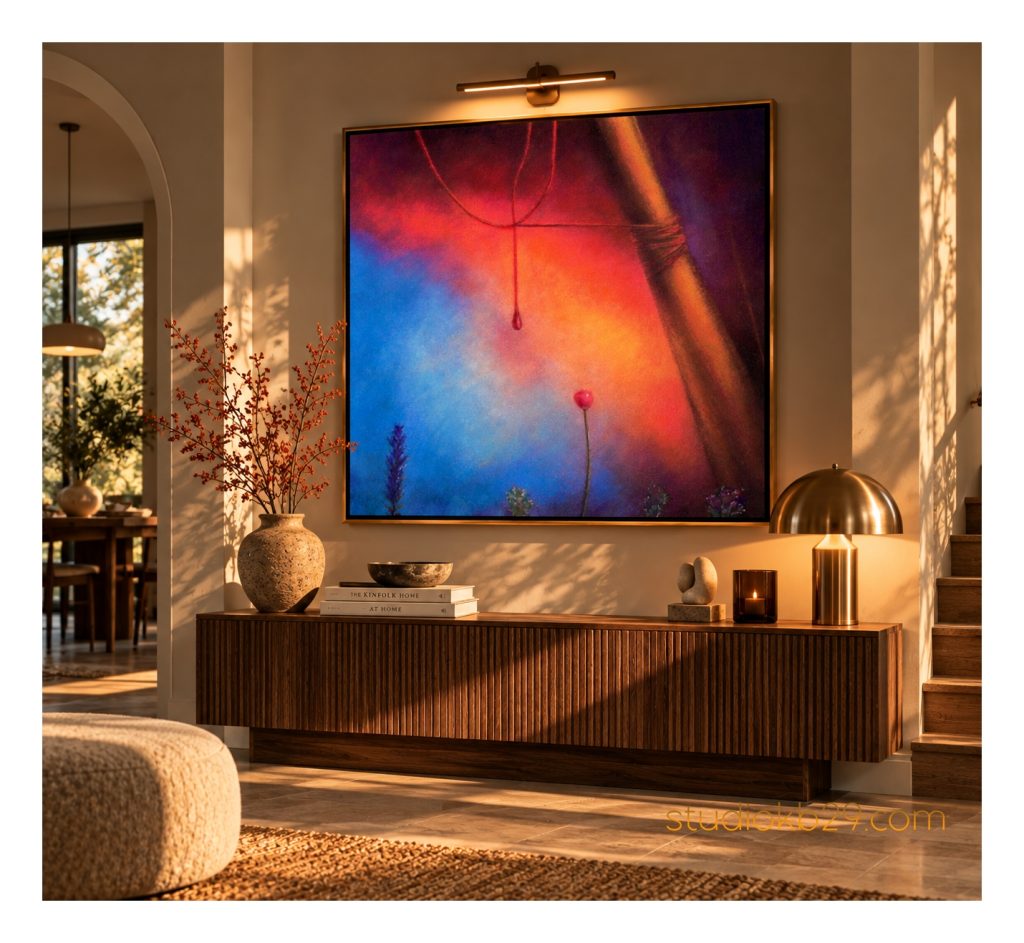
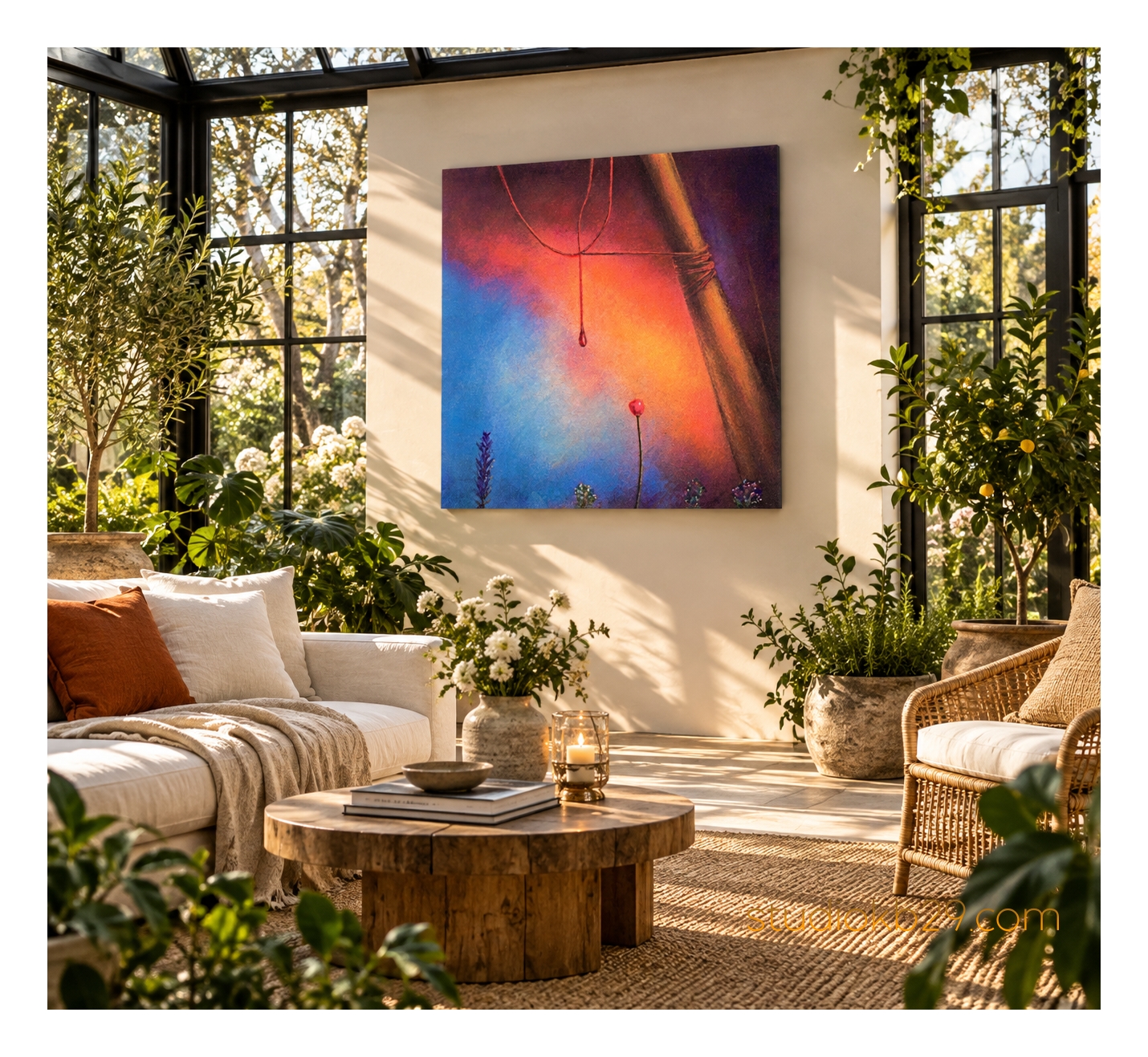
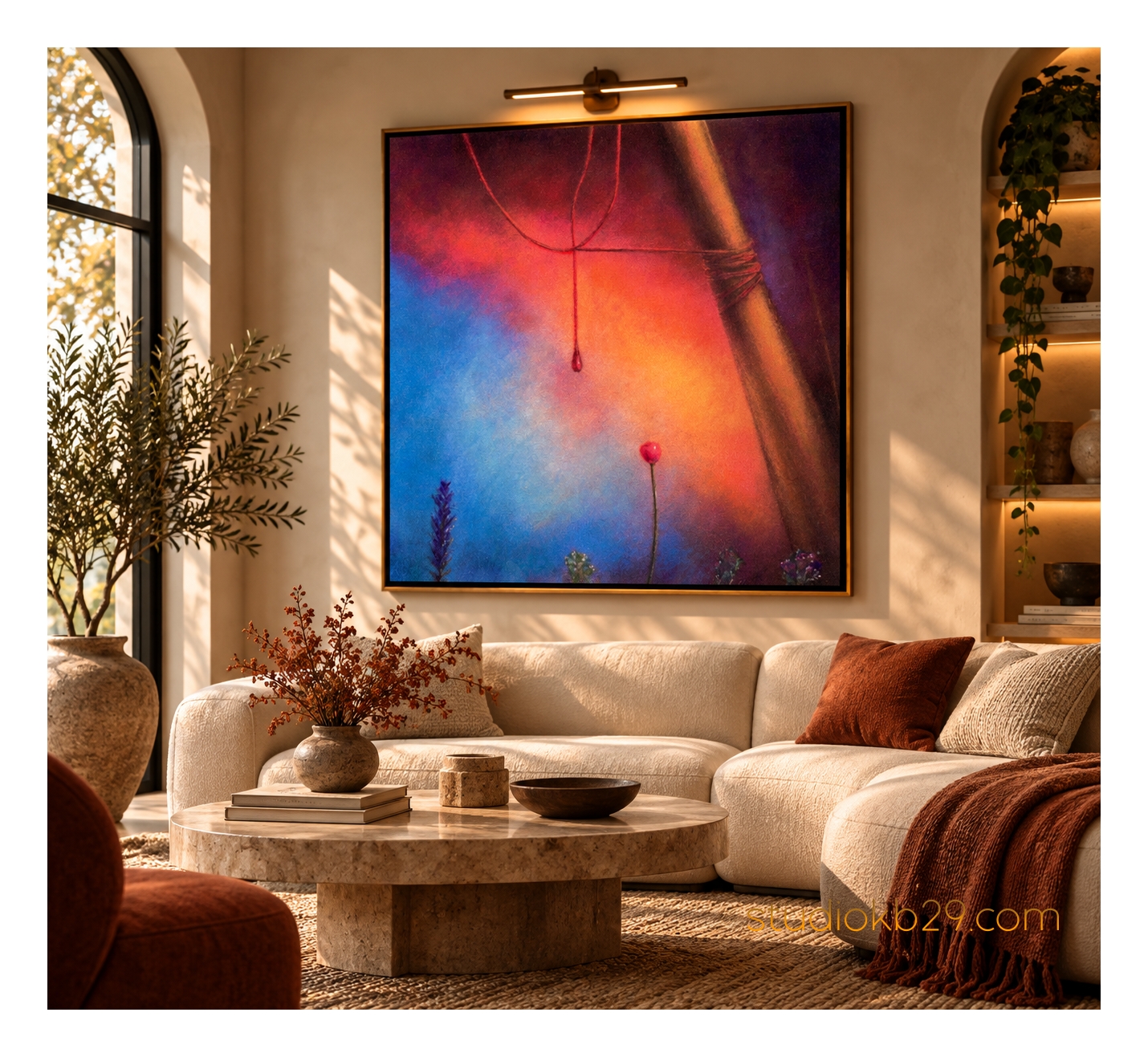
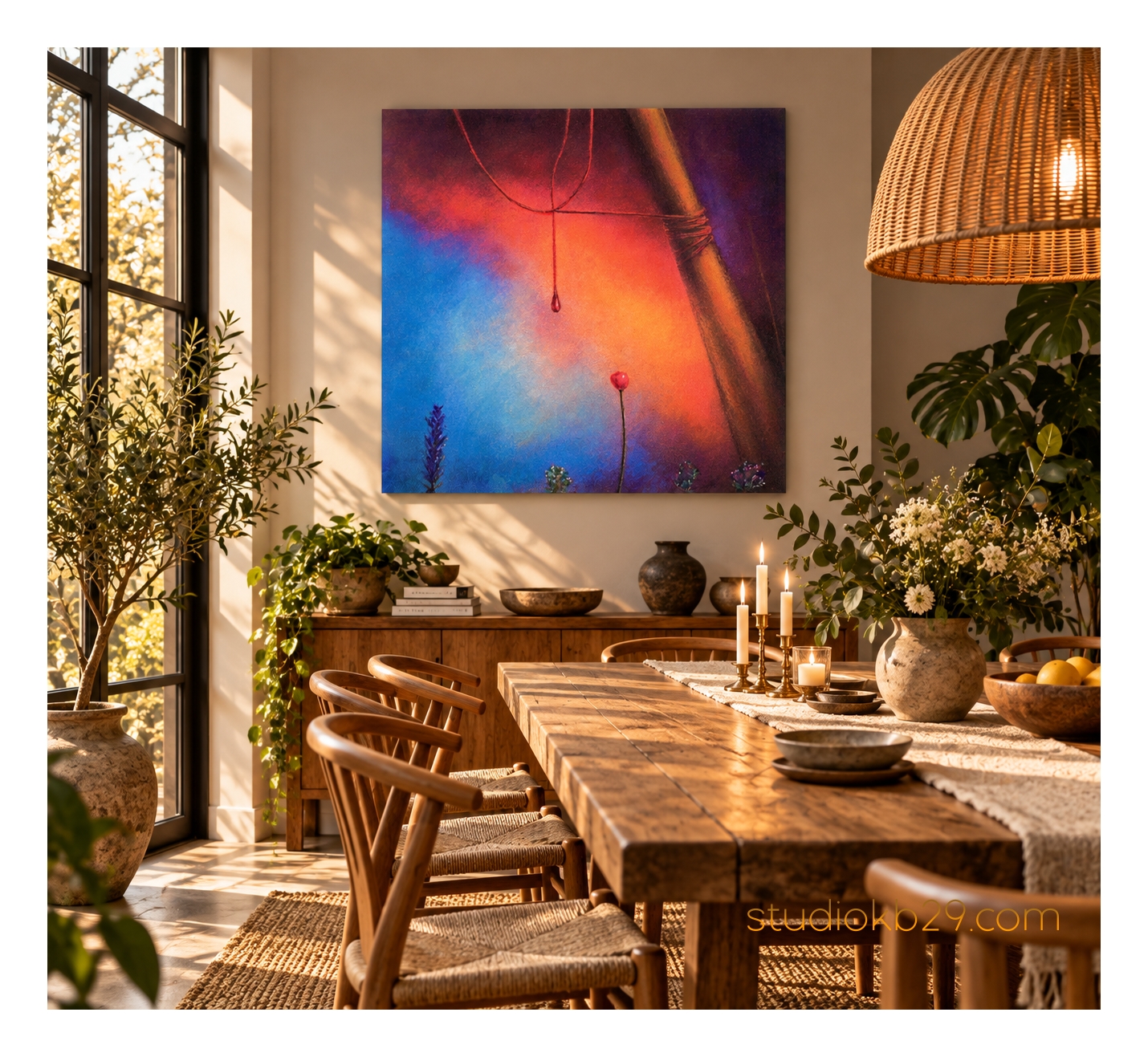
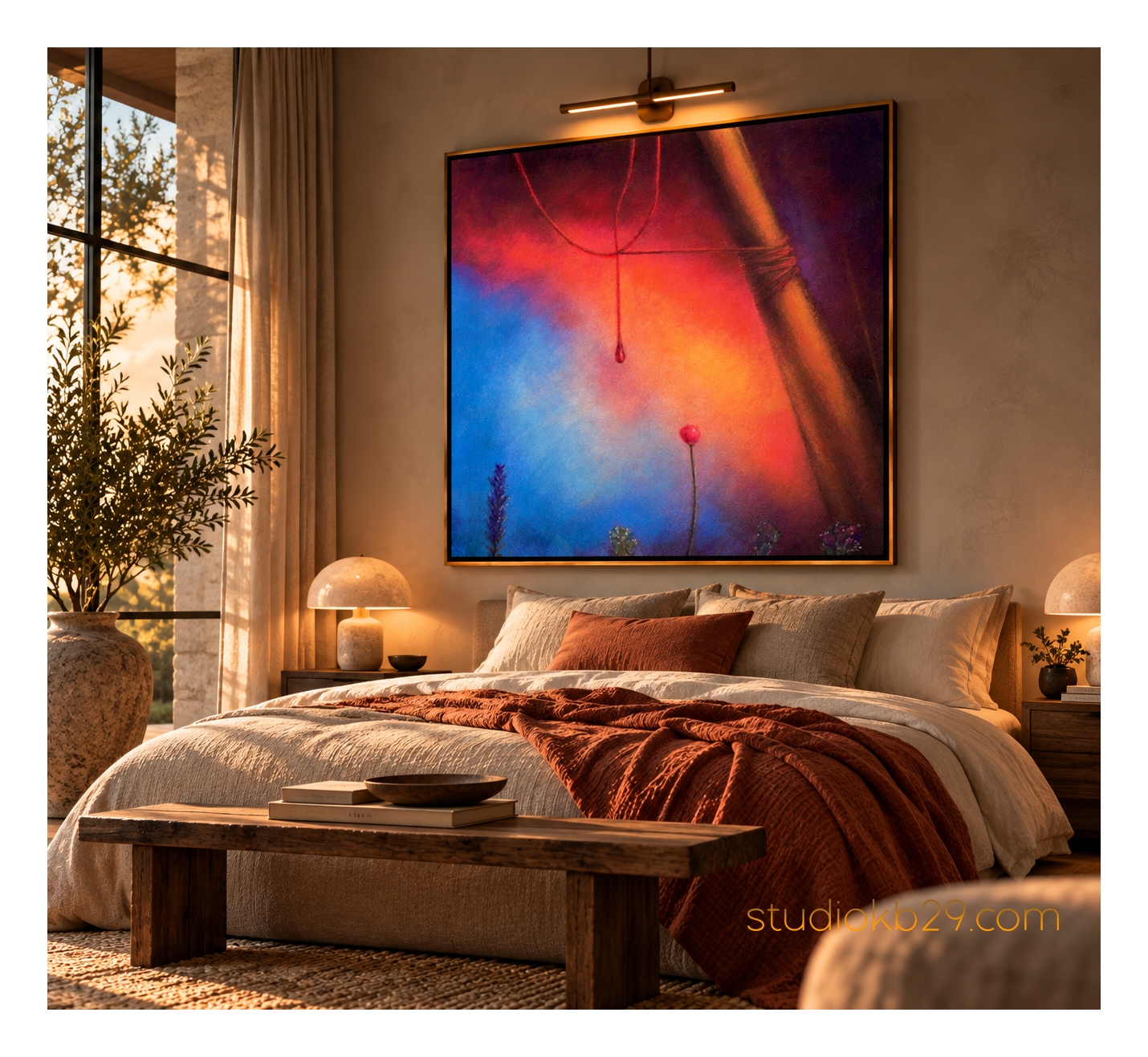
A luminous field of colour unfolds in an atmosphere of vivid coral, warm orange, soft violet and cool turquoise blue. Across this shifting background, slender lines intersect and curve around an elongated, sculptural form, creating an enigmatic arrangement that seems to exist somewhere between an abstract construction and an imagined organic system.
The composition balances contrasting visual elements: the weight of a curved, solid structure against the delicacy of fine lines; the intensity of saturated colour against the restraint of sparse, botanical suggestions. A single suspended droplet-like form draws the eye towards the centre, while a small, vivid red accent emerges from a slender stem below. Along the lower edge, delicate plant-like silhouettes appear almost as fragments of another world, their identities remaining deliberately unresolved.
Nothing in the image belongs entirely to the familiar. The curved structure might suggest a fragment of an imaginary apparatus, an unfamiliar architectural detail or an abstract organic form. The fine lines could be read as threads, tendrils or traces of an invisible network. Yet the artwork does not commit to any single interpretation.
Instead, these elements inhabit a surreal space in which structure and spontaneity, the constructed and the organic, seem to overlap. The surrounding colours dissolve into one another, creating a sense of depth that feels atmospheric rather than strictly spatial.
The result is an artwork of quiet tension and poetic ambiguity. Its forms appear suspended between connection and separation, while the luminous colour field creates the impression of an unfamiliar world emerging from light and shadow.
The Fragile Geometry of Dreams
At the centre of the composition lies a delicate relationship between structure and uncertainty.
The elongated curved form establishes a strong visual direction, descending diagonally through the right side of the image. Its solidity contrasts with the fine lines that cross the upper part of the composition, tracing irregular paths and creating a fragile network of connections.
These lines introduce a subtle geometric order without producing a rigid or symmetrical arrangement. Their intersections feel provisional, as though the structure might be held together by delicate threads rather than fixed architectural principles.
A single line descends from the upper intersection, ending in a small droplet-like shape. This suspended detail creates a moment of stillness within the surrounding movement, drawing attention to the relationship between the visible structure and the space around it.
Below, isolated botanical forms introduce a contrasting sense of emergence. Their slender stems and small, simplified heads suggest the possibility of growth, yet they remain fragments of an imagined environment rather than recognisable plants.
The composition therefore exists between several states: constructed yet organic, restrained yet expressive, stable yet potentially fragile.
This ambiguity gives the artwork its distinctive surreal character. It does not depict a dream in a literal sense; instead, it evokes the peculiar internal logic of dreams, where familiar visual elements combine in unexpected ways and acquire meanings that remain open to interpretation.
Between Constructed Form and Imagined Nature
The artwork brings together two contrasting visual languages.
The curved, elongated structure introduces a sense of physical presence. Its warm, muted surface stands apart from the surrounding colour field, creating a visual anchor within the composition.
In contrast, the thin lines appear almost weightless. They cross the image with an irregular, spontaneous rhythm, suggesting connections that are visible yet difficult to explain. Their relationship to the central form remains ambiguous: they seem to follow it, intersect with it and extend beyond its boundaries, without revealing a clear purpose.
The small plant-like elements below introduce another layer of uncertainty. Their delicate silhouettes suggest organic growth, but they are not intended to represent a specific botanical species. They appear instead as imaginative forms emerging at the edge of an abstract world.
This interplay between constructed and organic elements is central to the artwork’s visual identity. The image creates a space where lines may become tendrils, structures may suggest unfamiliar organisms, and abstract forms may evoke traces of life without becoming literal representations.
The result is a composition that feels both carefully arranged and quietly unpredictable.
A Luminous Atmosphere of Contrasting Colours
Colour plays a defining role in the mood and spatial character of the artwork.
Intense coral and warm orange dominate the central and upper areas, creating a sense of radiance and warmth. These tones gradually transition into cool turquoise and blue towards the left, while muted violet and deeper reddish shadows gather around the outer edges.
The contrast between warm and cool colours gives the image its distinctive visual energy. The orange and coral areas appear almost illuminated from within, while the blue introduces a cooler, more contemplative counterpoint.
Rather than creating a conventional background, the colour field becomes an active part of the composition. Its soft transitions suggest an atmosphere that continues beyond the visible forms, making the entire image feel suspended within an undefined space.
The warmer tones also connect visually with the curved structure, while the cooler blue area provides a contrasting setting for the delicate lines and small botanical accents.
The result is a balance of intensity and restraint: vivid colour creates an immediate impression, while the sparse, enigmatic forms reward closer attention.
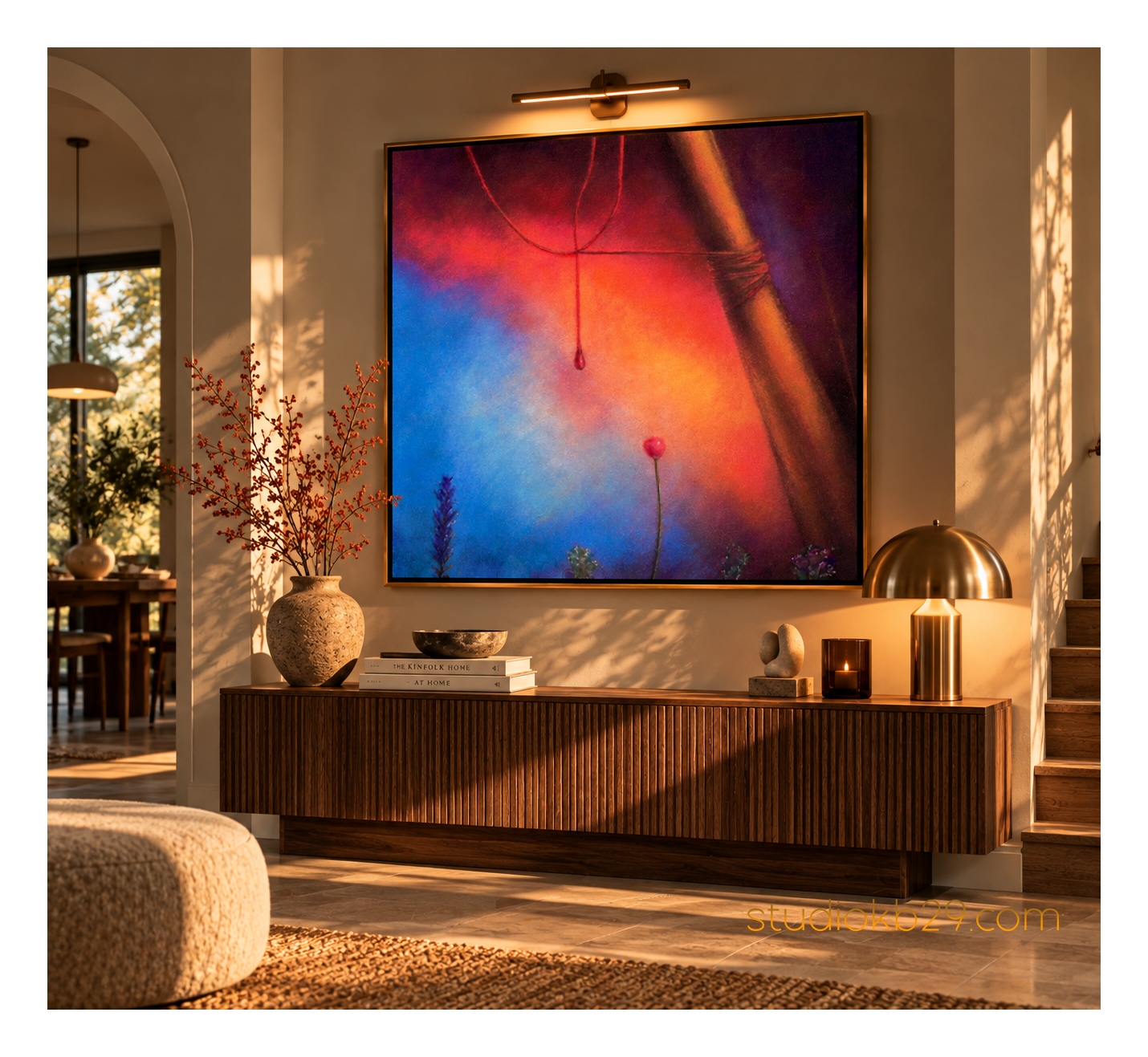
For interior design, this combination offers an expressive alternative to more neutral abstract art. The artwork can introduce colour and personality into a carefully curated space while retaining an atmospheric quality that avoids a purely decorative effect.
Organic Fragments in an Imaginary Space
The small plant-like forms along the lower edge provide a subtle counterpoint to the larger structures above.
Their slender stems and delicate silhouettes suggest the beginnings of growth, yet they remain intentionally ambiguous. Some appear as fine vertical accents, while others dissolve into the surrounding colours and textures.
These fragments introduce a sense of scale, suggesting that the larger forms belong to an environment that extends beyond the boundaries of the composition.
At the same time, their reduced, almost symbolic appearance prevents the image from becoming a conventional botanical painting. Nature is present here as an imaginative possibility rather than a subject reproduced from observation.
The relationship between these forms and the lines above creates a quiet visual dialogue. Both are slender, delicate and seemingly capable of extending beyond the visible frame, linking the lower and upper parts of the image without establishing a literal narrative.
This is where the artwork’s surreal quality becomes particularly apparent: imagined structures and hints of organic life share the same visual space, neither fully separate nor entirely distinguishable.
A Distinctive Artwork for Contemporary Interiors
With its expressive colour contrasts, delicate linear elements and ambiguous sculptural form, The Fragile Geometry of Dreams offers a distinctive interpretation of surreal abstract art.
The composition combines the visual clarity of a few strong shapes with an atmospheric background that adds depth and emotional nuance. Its vivid coral and orange tones introduce warmth, while turquoise, violet and darker accents create contrast and sophistication.
Ideal for:
- Contemporary residential interiors and statement walls
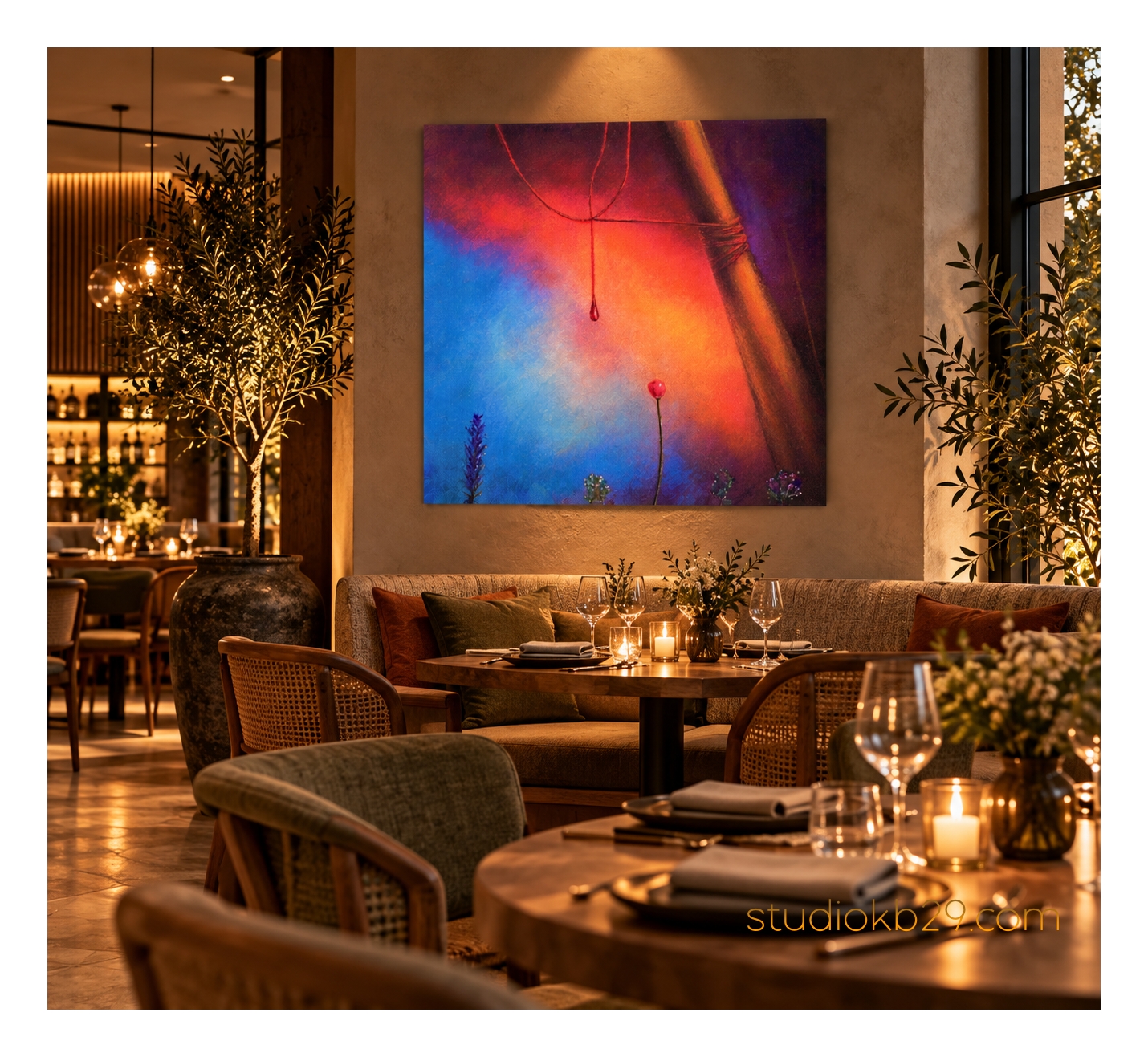
- Boutique hotels and design-led hospitality environments
- Creative studios, galleries and architectural practices
- Reception areas and curated commercial spaces
- Modern living spaces with expressive colour accents
- Interiors combining sculptural objects, organic forms and abstract art
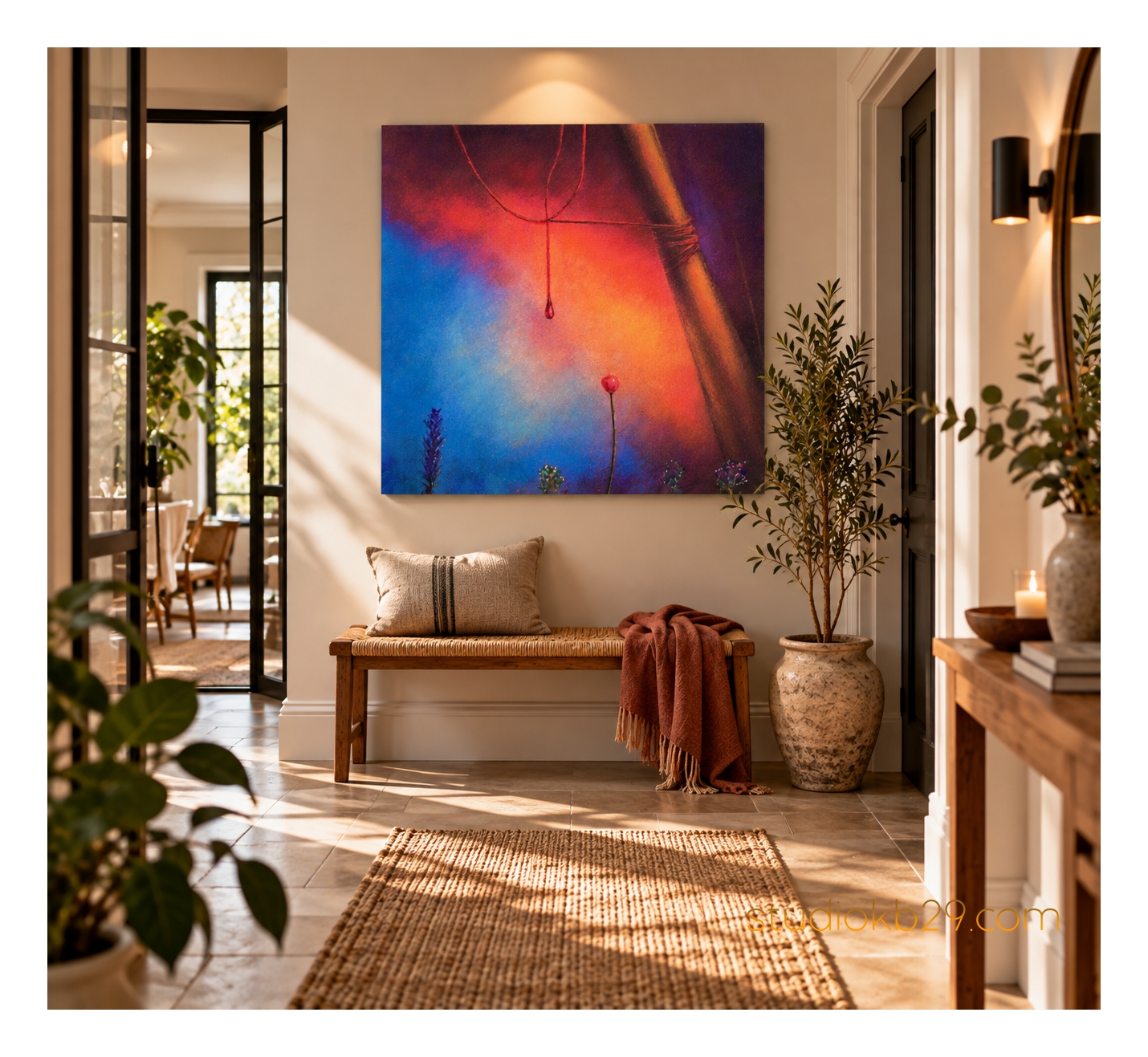
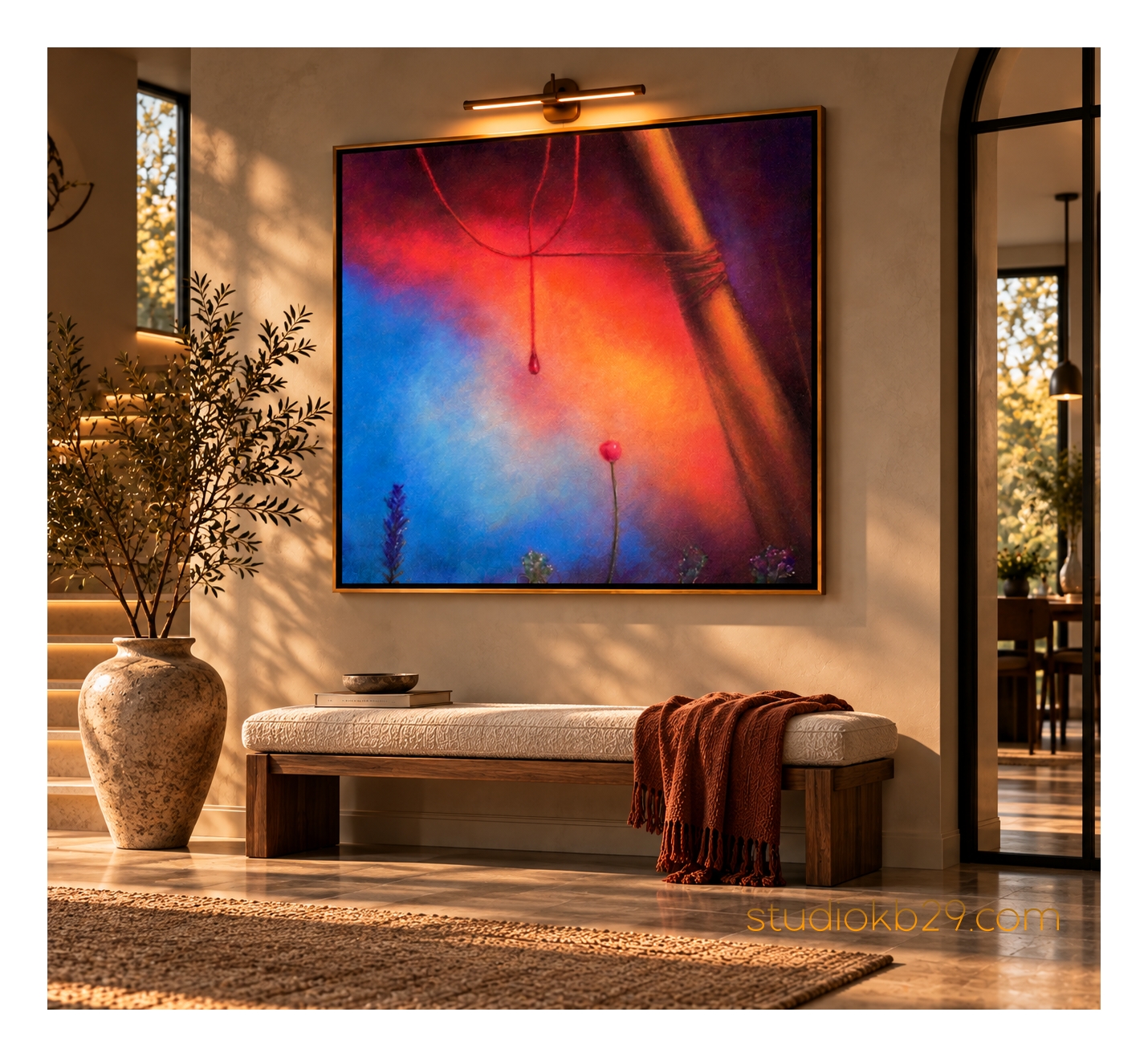
In restrained interiors, the artwork can serve as a focal point that introduces colour without relying on a recognisable subject. In more expressive environments, it can complement coral, rust, terracotta, turquoise and deep violet accents.
Its combination of strong diagonals and delicate linear details also makes it suitable for interiors that balance architectural structure with softer, more organic materials.
Rather than offering a fixed narrative, the artwork creates an open-ended visual experience that can be interpreted differently depending on the surrounding space and the viewer’s perspective.
Integrating the Artwork into an Interior Concept
The colour palette offers several possibilities for interior styling.
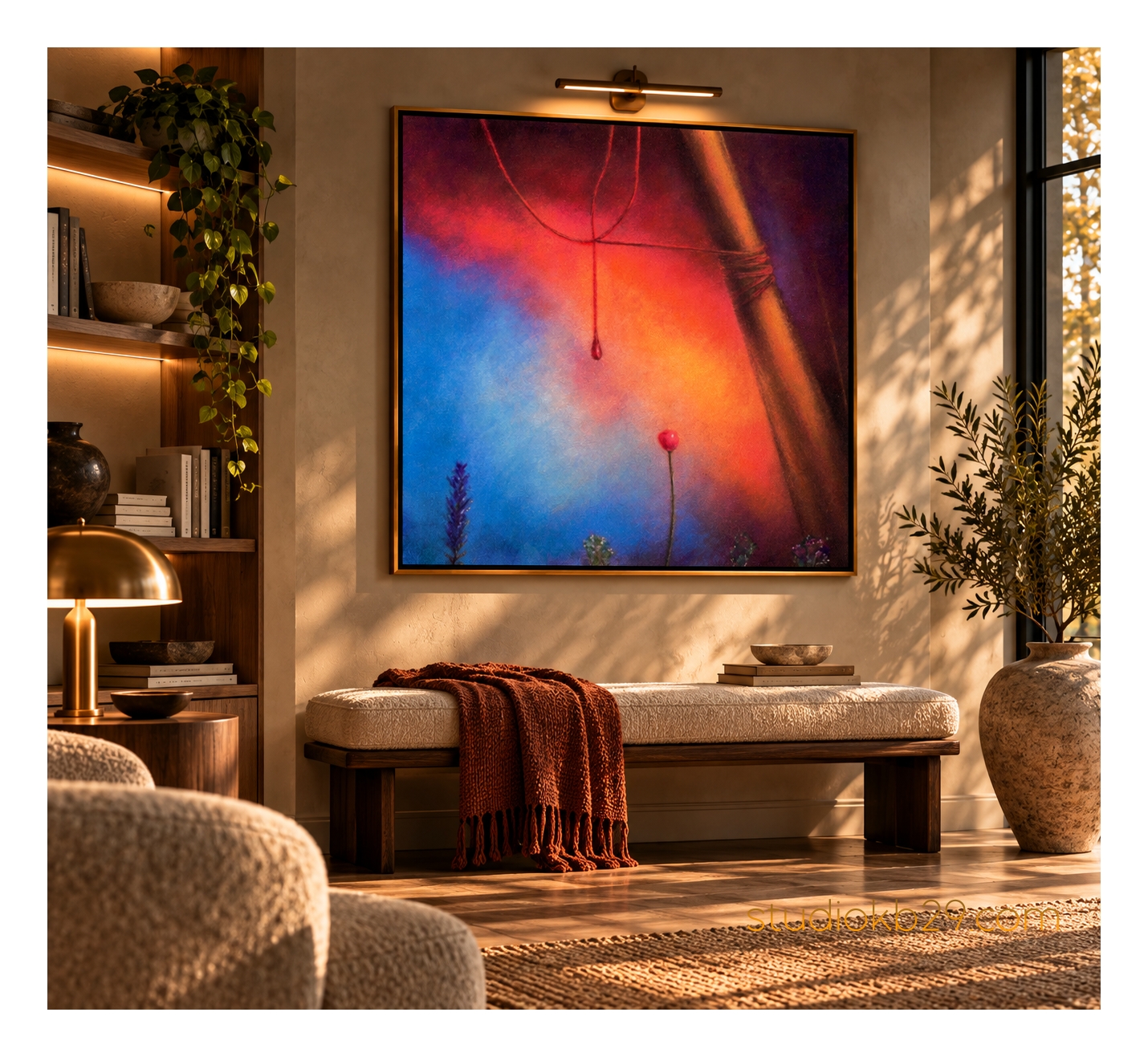
Warm timber, terracotta and muted rust tones can reinforce the coral and orange areas, creating a cohesive, warm atmosphere. Turquoise textiles or carefully selected blue-green accents can establish a stronger relationship with the cooler areas of the image.
For a more understated approach, the artwork can be placed against warm white, soft beige or muted grey walls, allowing its saturated colours and unusual forms to provide the principal visual accent.
Black or dark bronze details can echo the fine linear elements and darker contours, while glass, stone and smooth architectural surfaces can complement the contrast between solidity and transparency suggested by the composition.
A minimal frame can preserve the image’s sense of openness, while a dark frame can emphasise its deeper tones and create a more defined presentation.
For interior designers, the artwork offers flexibility across a range of concepts, from expressive contemporary residential projects to design-led hospitality environments.
Multiple Print Materials. One Imaginary World.
Available in a selection of print materials, this surreal abstract artwork can be adapted to different interior concepts and presentation preferences.
Canvas
A painterly presentation that complements the soft colour transitions and atmospheric qualities of the composition.
Metal
A contemporary option for modern interiors, architectural environments and design-led commercial spaces.
Wood
A natural material choice that can introduce warmth alongside the artwork’s vivid colour contrasts.
Acrylic
A sleek, contemporary presentation suited to interiors where a clean finish and modern material aesthetic are desired.
Paper
A classic art-print format offering flexibility through a choice of framing options. Particularly suitable for curated residential interiors, galleries and projects where the frame forms an integral part of the design.
Material availability and finishes may vary by selected format.
Framing to Complement Your Design Vision
The frame can influence how the artwork’s unusual forms and vivid colours relate to the wider interior.
A slim black frame can emphasise the linear elements and darker contours, giving the composition a precise, contemporary edge. Natural wood can introduce warmth and soften the contrast between the image and its surroundings.
A darker timber frame can complement the deeper violet and reddish-brown tones, while a minimal, understated frame allows the luminous coral and turquoise areas to remain the focus.
A choice of framing options and frame styles allows the presentation to be coordinated with the wider interior concept, whether the artwork is intended for a private residence, a boutique hospitality project or a curated commercial environment.
Ready to Hang. Ready to Integrate.
Your selected artwork arrives ready to hang, helping simplify installation and the final stages of interior styling.
For interior designers, architects and project specifiers, the choice of print material and framing offers flexibility when incorporating the artwork into a complete design concept.
Its expressive colour palette can be coordinated with furnishings, textiles, lighting and architectural finishes, while its unusual combination of curved structures, fine lines and imagined botanical forms introduces an individual artistic statement.
Whether displayed as a focal point in a residential interior or integrated into a curated hospitality or commercial project, the artwork offers a distinctive balance of colour, structure and interpretive openness.
The Fragile Geometry of Dreams – A Study in Surreal Abstraction
The Fragile Geometry of Dreams explores the delicate boundary between constructed form and imagined organic life.
A curved, sculptural element and a network of fine lines emerge against a luminous field of coral, orange, turquoise and violet. Small, plant-like forms appear along the lower edge, adding subtle suggestions of growth without defining a recognisable natural scene.
The composition brings together solidity and fragility, vivid colour and quiet detail, creating an atmosphere that feels suspended between an abstract construction and an unfamiliar dreamscape.
Expressive yet restrained, the artwork invites the viewer to explore the relationships between its forms without imposing a single interpretation.
A luminous world of delicate connections, where imagined structures and traces of organic life converge in the fragile geometry of a dream.